
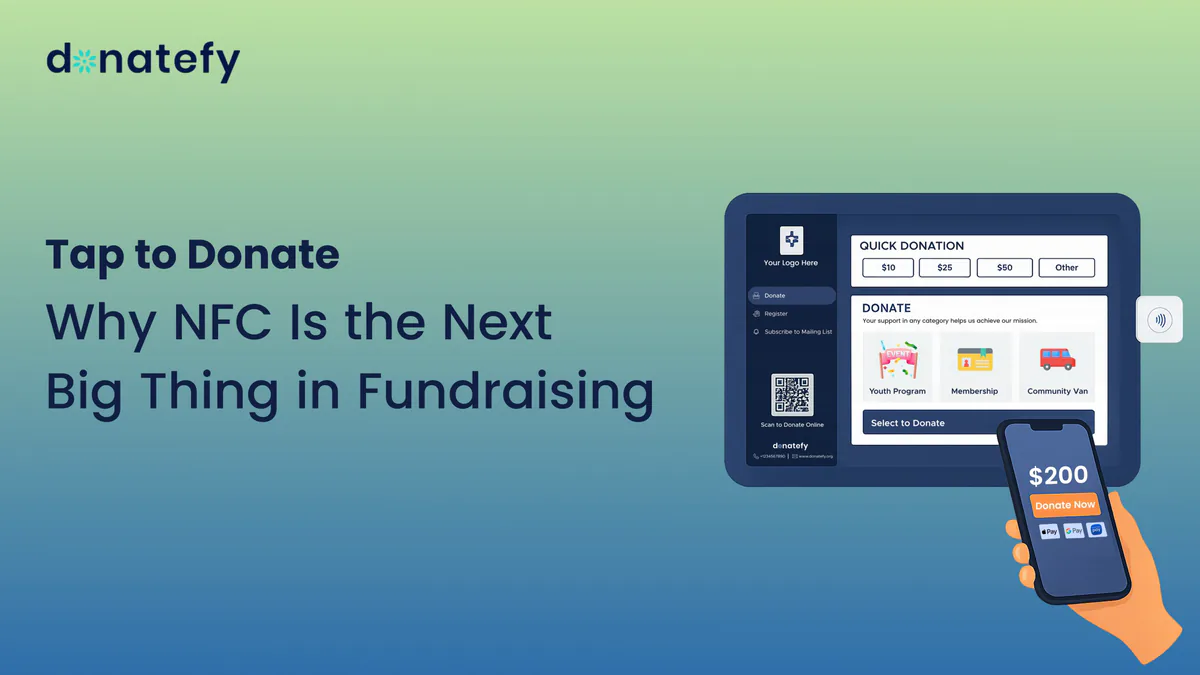
Walk into any café, store, or train station and you will see it: people tap a card or phone and move on. Quick, effortless, normal. Contactless payment, built on near-field communication (NFC), has become the everyday way many people pay, and fewer of them carry cash at all.
For nonprofits, the message is clear. If your donors tap to pay everywhere else, your fundraising needs to accept a tap too.
At Donatefy, we help nonprofits make that shift. NFC makes giving effortless, keeps donors engaged, and is setting the pace for how in-person fundraising works. The only question is whether you are ready to tap into it.
Why traditional giving loses the moment
Picture this: a donor is moved by your cause at an event and ready to give, but they have no cash. Typing a long web address and filling in a form on a small screen feels like too much work in the moment. In seconds, that spark of generosity fades.
Today's donors live in a tap-and-go world. Whether they are buying coffee, catching a train, or shopping online, convenience shapes their choices. If giving feels harder than buying a latte, you are losing donations you never even see.
That is where tap-to-donate giving comes in. It is the simplest way to start capturing donations in the moment, before the spark fades.
1. Contactless giving
The cash box belongs to another era. A Donatefy donation kiosk has an integrated tap and chip card reader, so donors give in seconds by tapping a card or phone, including Apple Pay and Google Pay.
No long forms and no hunting for change. The donor picks a campaign, chooses an amount, taps, and the gift is done, with a receipt on its way. When giving feels this easy, more of the people who mean to give actually do.
2. Recurring donations made simple
One of the biggest challenges for any nonprofit is keeping support going beyond a single gift. A tap can start that relationship.
At a Donatefy kiosk, a donor can start a monthly plan with a card tap and get a receipt by email, with no long form and no manual entry. Donors then manage their plans themselves in the Donor Portal.
Recurring giving matters because a monthly donor's support continues long after the first moment of generosity. By removing friction at the point of giving, a tap turns walk-up generosity into predictable support.
3. Giving that travels with the donor
Visitors are some of the hardest supporters to reach. A tourist at your museum, a guest at a family celebration, or a traveler passing through your building may never visit your website, and is unlikely to carry spare cash.
Digital wallets such as Apple Pay and Google Pay remove that barrier. The card is already on the phone, so a visitor can give in the moment without creating an account or typing card details. For museums and attractions, that turns daily foot traffic into supporters at entrances and exhibit exits.
4. Giving that is easier for everyone
Tapping is not only for tech-savvy supporters. It makes giving more inclusive, because one simple motion works for donors of every generation:
- Supporters who pay with their phone give the same way they pay everywhere else.
- Donors who find apps and online forms frustrating can give with a familiar tap of their card.
- Busy donors give in seconds, on the way into a service or out of an event.
Fewer barriers mean you can reach a wider audience and welcome people who were never going to fill in a form.
Benefits of NFC fundraising for nonprofits
- More completed gifts. Less friction means fewer donors give up halfway.
- A better donor experience. Giving is fast and private, because card details are captured by Stripe, and full card numbers are never stored on Donatefy servers.
- Less cash to handle. No counting, no deposit runs, and no envelopes to reconcile.
- Room to grow. Start with one phone at a pop-up drive and add a kiosk in every building, all on the same platform.
- Clear reporting. Every tap lands in your ledger tagged with its campaign and device, right beside your online gifts.
To see how card details stay with Stripe and where the money goes, read about secure donation processing at Donatefy, or browse the payments and security FAQs.
Where tap-to-donate fits in Donatefy
Contactless giving works on every Donatefy in-person fundraising channel, and all of them share the same campaigns, receipts, and ledger:
- Kiosks. The FS-22, a floor-standing contactless donation kiosk, and the WM-22 wall-mounted kiosk give your lobby a giving point that is always ready, with an integrated tap and chip card reader.
- Handhelds. The Stripe Reader S700 and Stripe Reader S710, made by Stripe and provisioned by Donatefy, are a handheld card reader for nonprofits: volunteers carry them table to table at galas, banquets, and drives, with contactless payment built in.
- Phones. The Donatefy Mobile App is a tap to donate app for your team: it accepts contactless gifts on compatible phones with Tap to Pay on iPhone and Tap to Pay on Android, with no extra hardware.
Your organization owns its hardware outright: $1,000 for the FS-22, $700 for the WM-22, and $349 for a provisioned S700 or S710. Devices activate on the Starter plan and above. See hardware pricing.
The future of fundraising is a tap away
Cash is fading, and contactless payment keeps growing. Nonprofits that adapt will meet donors where they already are, while those that rely on cash boxes and paper forms will keep missing gifts they never see. NFC is more than a new tool. It is the bridge between a donor's intent and a completed gift.
Donatefy brings that bridge to every place your community gathers, with kiosks, handheld readers, and phones that make generosity easier and faster.
Your donors already live in a tap-and-go world. It is time your fundraising caught up.
Frequently asked questions
What is tap to donate?
Tap to donate means giving by holding a contactless card, phone, or watch near a reader, the same way people tap to pay in a store. The reader can be built into a donation kiosk, a handheld card reader, or a phone running a giving app with Tap to Pay on iPhone or Tap to Pay on Android. The gift completes in seconds, with no form to fill in.
Does contactless giving increase donation amounts?
Contactless giving removes a common barrier, having no cash, so a gift reflects what someone meant to give rather than the bills in their wallet. Suggested amounts on the screen give donors a confident starting point, and a recurring option lets one tap become monthly support. How much that changes your totals depends on your traffic and placement, and every tap lands in your ledger tagged with its campaign and device, so you can see the effect for yourself.
Do donors need an app to tap to donate?
No. Donors tap the contactless card or phone wallet they already use, such as Apple Pay or Google Pay. Only your team needs the Donatefy Mobile App, and only to collect on their own phones; kiosks and handheld readers run the giving app themselves.
Can people tap to give at church?
Yes. A church giving kiosk in the foyer takes taps before and after services, volunteers can carry handheld readers or the Mobile App during special offerings, and a QR code in the bulletin covers anyone who would rather give from their seat.