
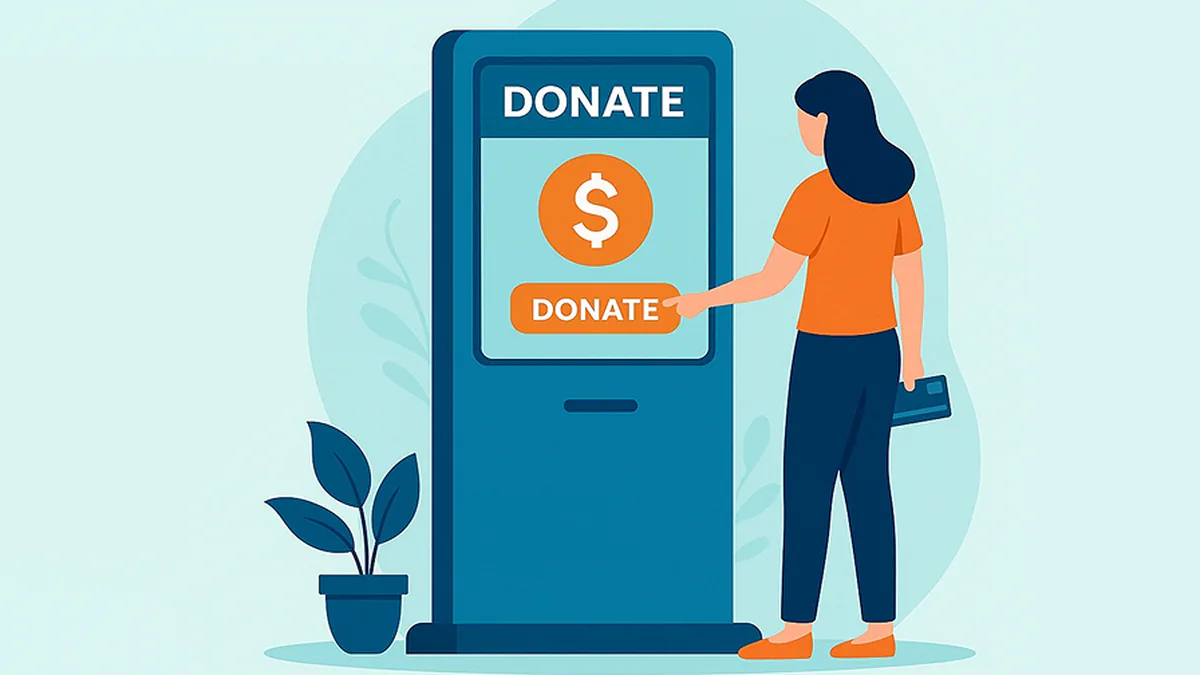
Supporters pay with a card or a phone almost everywhere they go. A collection box only catches the people who happen to carry cash, and a giving table only works while someone is standing behind it. Every visitor who wanted to give and could not is a gift your organization never sees.
A donation kiosk closes that gap. It turns the places your community already gathers into giving points that accept the way people actually pay, record every gift, and receipt every donor without anyone on staff stepping in. Here is why it has become one of the most practical tools a nonprofit can add, and how to make one part of your fundraising plan.
What a donation kiosk changes for a nonprofit
The biggest change is who gets to give. Without a kiosk, a gift in your building depends on cash in someone's pocket or a volunteer at a table. With one, anyone who walks in can give by card or phone the moment they decide to. For a full definition and the cost of owning one, see what a donation kiosk is and what it costs.
Kiosks work best where people already pass and pause: lobbies and entrances, event halls, hospitals, museums, community centers, and places of worship. Donatefy makes two formats with the same donor experience: the FS-22 floor-standing kiosk for prominent, flexible placement, and the WM-22 wall-mounted kiosk for a permanent giving point that uses no floor space.
1. Contactless giving that takes seconds
People give when giving is easy. Contactless cards and mobile wallets are part of everyday life now, so asking for cash or a check adds a step many donors cannot or will not take. The impulse to give rarely survives an extra step, which is the idea behind micro-moment giving: catch the gift while the feeling is fresh.
At a kiosk, a donor picks a campaign, chooses an amount, and taps a card or phone. Cards, Apple Pay, and Google Pay all work through the integrated reader, so a gift reflects what someone meant to give rather than what happened to be in their wallet. Donors can also choose to cover the processing fee, so more of each gift reaches your mission.
2. More places, and more hours, to collect gifts
A giving table needs a volunteer for every hour it is open. A kiosk needs no one beside it. It accepts gifts whenever your building is open, in the rush after a service or an event and in the quiet hours when your team is busy elsewhere.
Because each kiosk runs on its own, you can put one wherever it will do the most good: a gala, a museum entrance, a hospital lobby, a front desk. The FS-22 carries an 8-hour battery backup, so it can move to the event hall for an evening and return to the lobby the next morning. If you run a museum, zoo, or attraction, see how donation kiosks for museums and attractions work at entrances and exhibit exits.
3. Campaigns that tell your story on screen
A silent box asks for money. A kiosk can show people what their money does. Each campaign carries its own title, description, and imagery, and you can tie amounts to tangible outcomes such as meals, trees, or essential supplies.
Kiosks support recurring giving too. A donor can start a monthly gift with a single card tap, turning one moment of walk-up generosity into steady support, and later manage that plan in the Donor Portal. You choose which campaigns and amounts each kiosk shows from the Admin Portal, without touching the device.
4. Real-time reporting you can act on
Every kiosk gift lands in the same ledger as your online donations, tagged with the campaign and the device that collected it. The Admin Portal shows totals by device beside your other channels, along with each device's status, so a kiosk that has gone quiet gets noticed.
That data turns placement into a decision instead of a guess. You can see which location raises the most, which campaigns people respond to at the screen, and whether a kiosk would do better somewhere else.
5. A cost you can plan around, and easy to scale
Events and large campaigns take venues, materials, and many staff hours every time you run them. A kiosk is a one-time purchase that keeps collecting with very little staff time once it is set up.
Donatefy publishes its hardware prices: the FS-22 is $1,000 and the WM-22 is $700, both owned outright with Donatefy's one-year warranty. Devices activate on the Starter plan and above, with one device included on Starter and up to five on Growth. Adding a location means adding a device, not rebuilding your setup, and every kiosk runs the campaigns you manage from one place. See the full hardware pricing.
6. Built for the way younger donors pay
Many younger supporters rarely carry cash and expect to pay with a phone. A kiosk that takes mobile wallets meets them on familiar ground, which keeps your organization relevant to the next generation of donors without changing who you are.
The same simplicity helps everyone else. A clear screen, a few large choices, and a tap to finish work for donors of every age.
7. Visibility that builds trust
A well-placed, branded kiosk is a quiet advertisement for your mission. It tells everyone who passes that your organization is organized, current, and easy to support.
It also answers the questions careful donors ask. Payments are processed by Stripe, and card details are captured by Stripe rather than stored by Donatefy. Every donor gets a tax-ready receipt with your EIN, and donations settle directly into your organization's own Stripe account.
How to make a kiosk part of your fundraising plan
- Place it where people already pass. Entrances, lobbies, check-in desks, and waiting areas see steady traffic, and events add a natural moment to give.
- Feature urgent or relatable causes. A specific need with a clear image and an outcome-based amount gives people a reason to stop.
- Offer recurring giving at the screen. Some of your most loyal supporters will start as walk-up donors who chose monthly with a single tap.
- Connect kiosk gifts to your donor records. When a donor adds an email address for a receipt, the gift joins their donor record beside their online giving, so you can thank them and follow up like any other supporter.
- Share kiosk moments on social media. Photos from an event or progress on a kiosk campaign remind supporters that giving in person is easy, and bring more people to the screen.
Final thoughts
The easier you make giving, the more people get the chance to say yes. A donation kiosk captures generosity that would otherwise walk out the door, connects in-person gifts to the rest of your fundraising, and makes giving simple for donors of every age. Whether you run a small charity or a large foundation, it is one of the most practical additions you can make.
If you are weighing formats and placement, the donation kiosk buyer's guide walks through every decision.