A passionate founder once told me she lost a $50,000 grant because she checked the wrong box on an application. Her organization did incredible work in providing educational resources to underserved communities, but when the funder searched their database for “local nonprofits,” her organization didn’t appear. She’d registered as an “NGO” because it sounded more official.
That one checkbox cost her a year’s worth of programming.
Here’s what nobody tells you when you’re starting a social impact organization: The labels matter. Not just for grant applications, but for how donors find you, which funding opportunities you qualify for, and even how much trust you build with supporters.
Most founders think “nonprofit” and “NGO” are just different words for the same thing, fancy terms that mean “we’re doing good in the world.” However, misunderstanding this distinction doesn’t just create confusion; it leaves money on the table, limits your reach, and can even damage your credibility with donors who expect one thing but receive another.
Let’s break it down in a way that actually matters for your mission.
The Fundamental Distinction: Nonprofit vs NGO
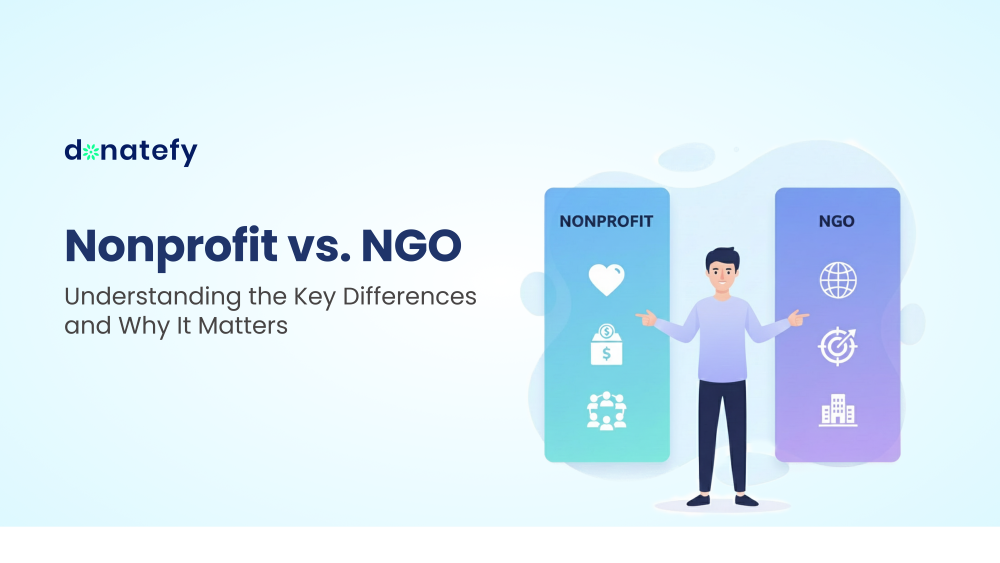
Here’s the simplest way to think about it: All NGOs are nonprofits, but not all nonprofits are NGOs.
Like how all golden retrievers are dogs, but not all dogs are golden retrievers. The terms aren’t interchangeable; one is a subset of the other.
But here’s where it gets interesting: The real difference isn’t just technical. It’s about how you see your mission, where you operate, and who you’re trying to reach.
What Is a Nonprofit Organization?

Think of nonprofits as the umbrella term, the big tent that includes any organization putting mission before money.
A nonprofit is any entity that:
- Operates to benefit society rather than enriching owners or shareholders
- Reinvests every dollar earned back into its mission
- Qualifies for tax-exempt status in most countries (like 501(c)(3) in the U.S.)
The beauty of nonprofits? They’re incredibly diverse. Your neighborhood animal shelter is a nonprofit. So is Harvard University. So is your local community theater and the hospital down the street.
In the United States alone, there are over 1.5 million nonprofit organizations, employing more than 12 million people and contributing over $1 trillion annually to the economy, according to USA Facts.
From tiny volunteer-run food pantries to massive healthcare systems, nonprofits are the backbone of civil society. They fill the gaps that government and business leave behind, and they do it without expecting profit in return.
So What Makes an NGO Different?
NGO stands for Non-Governmental Organization, and that name tells you almost everything you need to know.
NGOs are nonprofits with a specific flavor:
- They operate independently from any government (hence “non-governmental”)
- Their focus is typically international or cross-border
- They tackle big-picture issues: humanitarian crises, human rights, environmental protection, international development
- They often work in multiple countries simultaneously
The difference isn’t the cause, but it’s the scope of the solution. Nonprofits act locally to meet immediate needs; NGOs operate internationally to change systems, policies, and conditions that create those needs in the first place.
Nonprofit Vs. NGO: Key Differences and Similarities
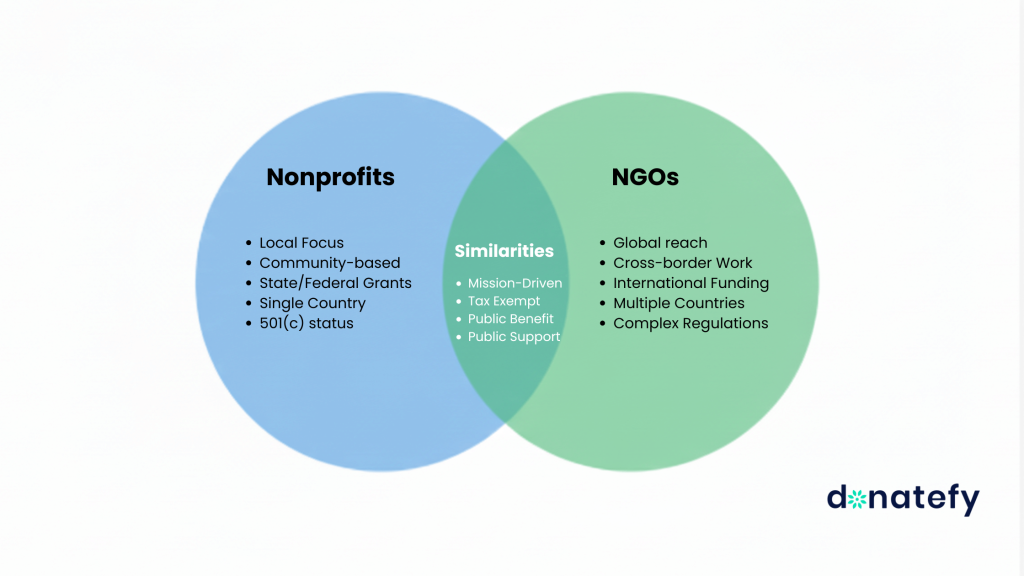
Real-World Examples
Organizations That Are Nonprofits But NOT NGOs
- Local community food bank serving one city
- University alumni association
- Regional theater company
- Neighborhood homeowners association
- Professional trade organization for accountants
Organizations That Are BOTH Nonprofits AND NGOs
- Doctors Without Borders – Medical humanitarian aid internationally
- Oxfam International – Poverty alleviation worldwide
- World Wildlife Fund (WWF) – Global conservation
- Amnesty International – Human rights advocacy across borders
Quick Reference: Nonprofit vs. NGO at a Glance
| Aspect | Nonprofit | NGO |
| Geographic Scope | Local, regional, or national | International or cross-border |
| Common Usage | Widely used in the United States | Common outside the U.S. (Europe, Asia, Africa) |
| Primary Focus | Education, arts, healthcare, and community services | Humanitarian aid, human rights, development, advocacy |
| Funding Sources | Local donations, community grants, membership fees | International grants, UN agencies, and global foundations |
| Government Relationship | Often collaborative; may receive contracts | Operates independently; sometimes adversarial |
5 Key Differences That Actually Matter
1. Scale: Neighborhood vs. The World
Nonprofits range from small neighborhood initiatives, like food banks and community theaters, to larger organizations tackling broader community needs. Many focus primarily on serving local or regional populations
NGOs operate on an international stage. Union of International Associations profiles over 68,000 organizations worldwide, with the largest ones operating in more than 100 countries simultaneously.
“The difference often comes down to a simple question: Are you solving a problem that exists in one community, or are you addressing a challenge that transcends borders?”
2. Money: Where the Funding Flows From
Nonprofits typically receive:
- Individual local donors
- Community foundation grants
- State/federal government contracts
- Annual fundraising events
- Corporate sponsorships from local businesses
NGOs source funding from:
- International donors and multilateral agencies (UN, World Bank)
- Private global foundations
- Individual donors worldwide
- Foreign government development agencies
Real Talk: This diversified global funding base allows NGOs to maintain independence and operational flexibility across borders, but it also means navigating complex international donor requirements.
3. Legal Structure: Simple vs. Complex Compliance

U.S. Nonprofits must:
- Register as 501(c)(3) organizations with the IRS
- File annual Form 990 reports
- Comply with state-level regulations
- Average legal costs: $1,000–$3,000 annually (depends on setup)
NGOs face a far more complex reality:
- Navigate multiple legal systems simultaneouslyComply with international laws
- Register in each country where they operate (sometimes 10-15 separate registrations)
- Annual legal compliance costs: Vary widely depending on size, scope, and the number of countries of operation
4. Mission: What Drives the Work
Nonprofits address incredibly diverse causes:
- Healthcare (56%)
- Education (25%)
- Health and Human Services (50%)
- Religious Organizations (18%)
- Arts & Culture (3–4%)
NGOs concentrate on boundary-crossing issues:
- International development
- Humanitarian relief
- Human rights advocacy
- Environmental conservation
- Global health initiatives
5. Government Relations: Partners vs. Watchdogs
Nonprofits often partner closely with the government:
- Nearly 33% of nonprofit revenue comes from government sources
- Total government funding to nonprofits: over $300 billion annually in the U.S.
- Many essentially serve as government contractors (think Head Start programs or public housing management)
NGOs explicitly emphasize independence
- The “non-governmental” designation is central to their identity.
- NGOs often engage in government criticism or advocacy work
- Many operate in countries with restrictive government policies
- This autonomy allows NGOs to advocate for change, challenge government actions, and work where governments are unable or unwilling to act
Why This Actually Matters to YOU
For Donors and Supporters
Understanding the difference helps you make informed giving decisions:
- Want to support local community needs? → Local nonprofit
- Passionate about global issues like refugee assistance or climate change? → International NGO
Tax tip: U.S. taxpayers can deduct donations to U.S.-registered 501(c)(3) organizations, but donations to foreign NGOs may not qualify unless made through a U.S.-based intermediary.
For Job Seekers and Volunteers

Career paths differ dramatically:
Nonprofits offer:
- Deep impact in a specific community.
- Better work-life balance
- Roots in one location
- Hands-on community engagement
NGOs offer:
- International travel and cross-cultural experience
- Exposure to global issues
- Networking across countries
- But may demand flexible living arrangements and extended time abroad
For Founders and Social Entrepreneurs
Choosing between starting a nonprofit or an NGO depends on your mission scope:
Start a nonprofit if:
- You’re addressing a local or national need
- You want simpler registration and compliance
- Your funding will come primarily from local sources
- You’ll partner with local government or community organizations
Start an NGO if:
- Your vision is inherently international
- You’re prepared to navigate complex multi-country regulations.
- You can access international funding sources
- Independence from government is crucial to your mission
Busting Common Myths
Myth 1: NGOs don’t pay taxes
Truth: Like other nonprofits, NGOs are tax-exempt on mission-related income, but they still pay employment taxes and may owe taxes on unrelated business income.
Myth 2: Nonprofit means volunteer-run
Truth: Many nonprofits and NGOs employ paid professional staff. “Nonprofit” refers to how revenue is used, not whether people are compensated.
Myth 3: NGOs never receive government funding
Truth: Many NGOs do receive government grants or contracts. “Non-governmental” refers to independence in governance and decision-making, not funding sources.
Myth 4: All nonprofits are charities
Truth: Nonprofits include charities, but also professional associations, social clubs, labor unions, and advocacy organizations. Not all qualify for charitable tax-deductible donations.
Making Your Decision: The Questions to Ask Yourself
If you’re deciding where to donate:
- Do you want to see immediate, local impact or contribute to broader systemic change?
- Are you more passionate about issues in your community or global challenges?
- Do you prefer organizations where you can volunteer hands-on or those operating in distant locations?
If you’re considering starting an organization:
- What is the geographic scope of the problem I want to address?
- Do I have the capacity and resources to navigate international regulations
- Where will my funding come from: local or international donors?
- What type of organizational structure best serves my mission?
Wrapping Up
Whether you’re giving, volunteering, or building something new, understanding the nonprofit-NGO distinction empowers you to:
- Make smarter decisions about where to direct your resources
- Choose the right structure if you’re founding an organization
- Set realistic expectations about what different organizations can achieve
- Navigate funding opportunities more effectively
- Communicate your mission with clarity that builds trust
The world needs both. Local nonprofits create deep, lasting change in communities. International NGOs tackle systemic problems that cross borders. Both operate on the same beautiful principle: mission over profit.
Now you know the difference. And that knowledge? It might just be the key to unlocking your greatest impact yet.
No matter how your organization is classified, nonprofit, NGO, or something in between, Donatefy helps you turn clarity into action. From secure donation processing to powerful campaign and donor management tools, everything is built to help you raise more and build lasting donor trust.
Organizations using modern fundraising platforms raise to 30% more donations, not because they ask more, but because they communicate better and make giving easier.
That’s where impact compounds.
Trusted by mission-driven organizations to fundraise efficiently and transparently.
Start fundraising smarter with Donatefy. Checkout the Donatefy Blog for more fundraising insights and ideas.