
The shift from physical currency to a digital-first economy has completely redefined the “impulse to give.” In today’s fundraising landscape, the success of an in-person event isn’t just about the strength of your story; it’s about the speed of your technology. When a supporter is moved by your mission at a gala, a community center, or a house of worship, their first instinct is to reach for their phone or wallet. If your only options are a plexiglass “fishbowl” for cash or a complex URL they have to type into a mobile browser, you aren’t just losing a transaction; you’re losing a donor.
A donation kiosk is no longer a luxury “tech gadget” for large-scale nonprofits. In 2026, it is a strategic necessity that bridges the gap between physical presence and digital convenience. This guide breaks down the true value, total cost of ownership, and operational best practices for integrating donation kiosks into your fundraising strategy.
What Is a Donation Kiosk?
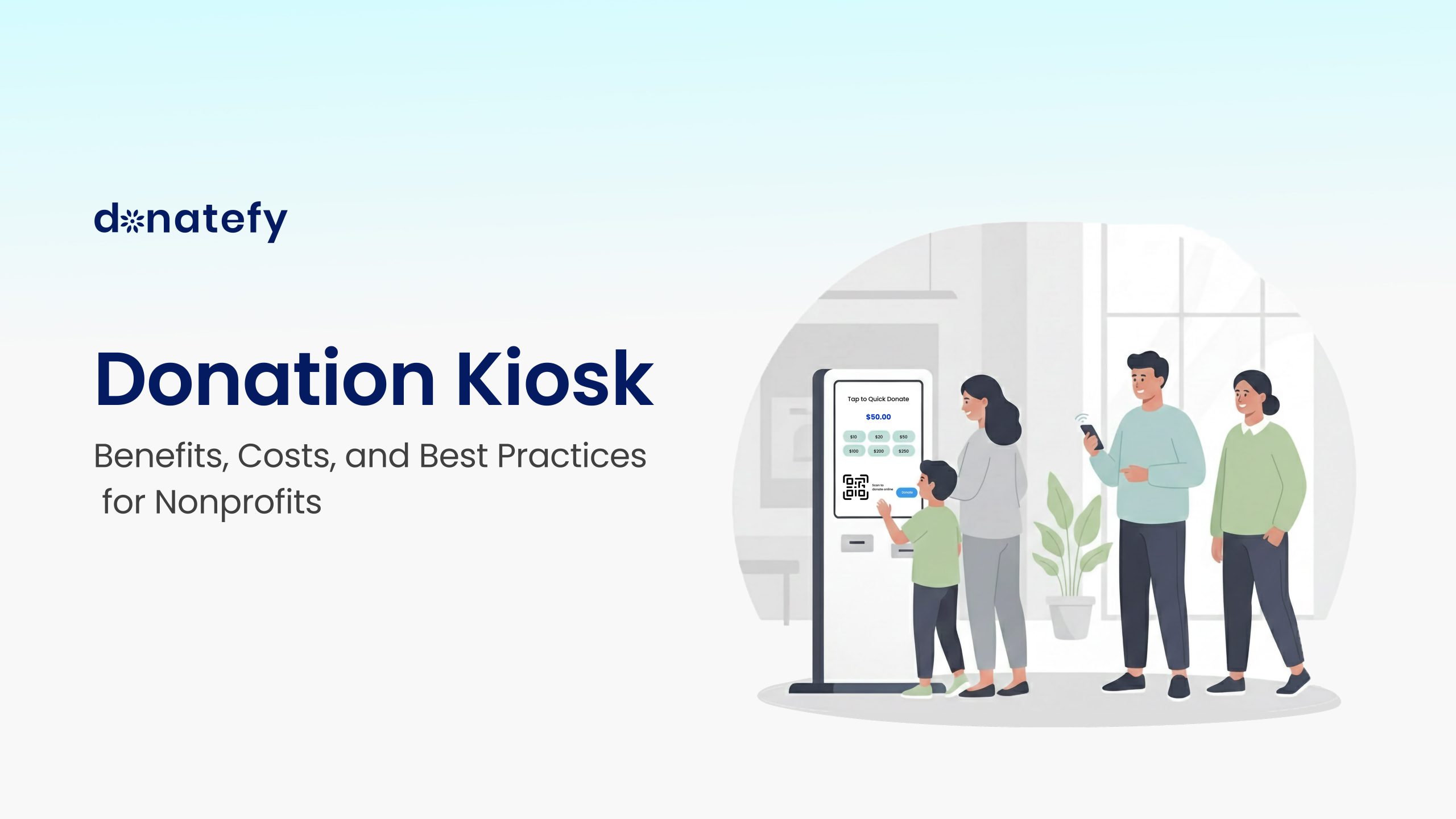
At its core, a donation kiosk is a secure, standalone point-of-sale (POS) terminal specifically engineered for charitable giving. Unlike a standard retail register, a donation kiosk is optimized for speed and emotional conversion.
These devices allow supporters to give via credit card, debit card, or digital wallets (Apple Pay, Google Pay) using “tap-to-pay” technology. They exist to eliminate the “I don’t have cash on me” barrier, turning high-traffic physical locations into passive, high-yield fundraising hubs.
Donatefy Donation Kiosk vs. Generic Retail POS
While many nonprofits consider using retail-focused tablets (like Square or Clover), there are fundamental differences in how a dedicated donation kiosk functions to maximize impact.
| Feature | Generic Retail POS (Square/Clover) | Donatefy Donation Kiosk |
| Primary Goal | Selling products/Inventory | Capturing donations/Impact |
| User Experience | Transactional (Cart, Checkout) | Emotional (Mission-led, 2-tap giving) |
| Recurring Giving | Difficult (Requires workarounds) | Native (One-tap monthly toggle) |
| Tax Receipts | Standard retail receipt | IRS-Compliant donor receipts |
| Donor Branding | Retailer’s branding is dominant | 100% Custom to your nonprofit |
| Donor Data | Limited to transaction info | Full CRM integration & email capture |
| Suggested Amounts | Not optimized for giving | Anchored “Impact Levels” (e.g., $50 feeds 5) |
| “Cover the Fees” | Rarely an option | Standard (85% of donors opt-in) |
Donation Kiosk Benefits for Nonprofits
The transition from a static donation box to a digital kiosk offers measurable advantages that directly impact your bottom line.
1. Increased Average Gift Size
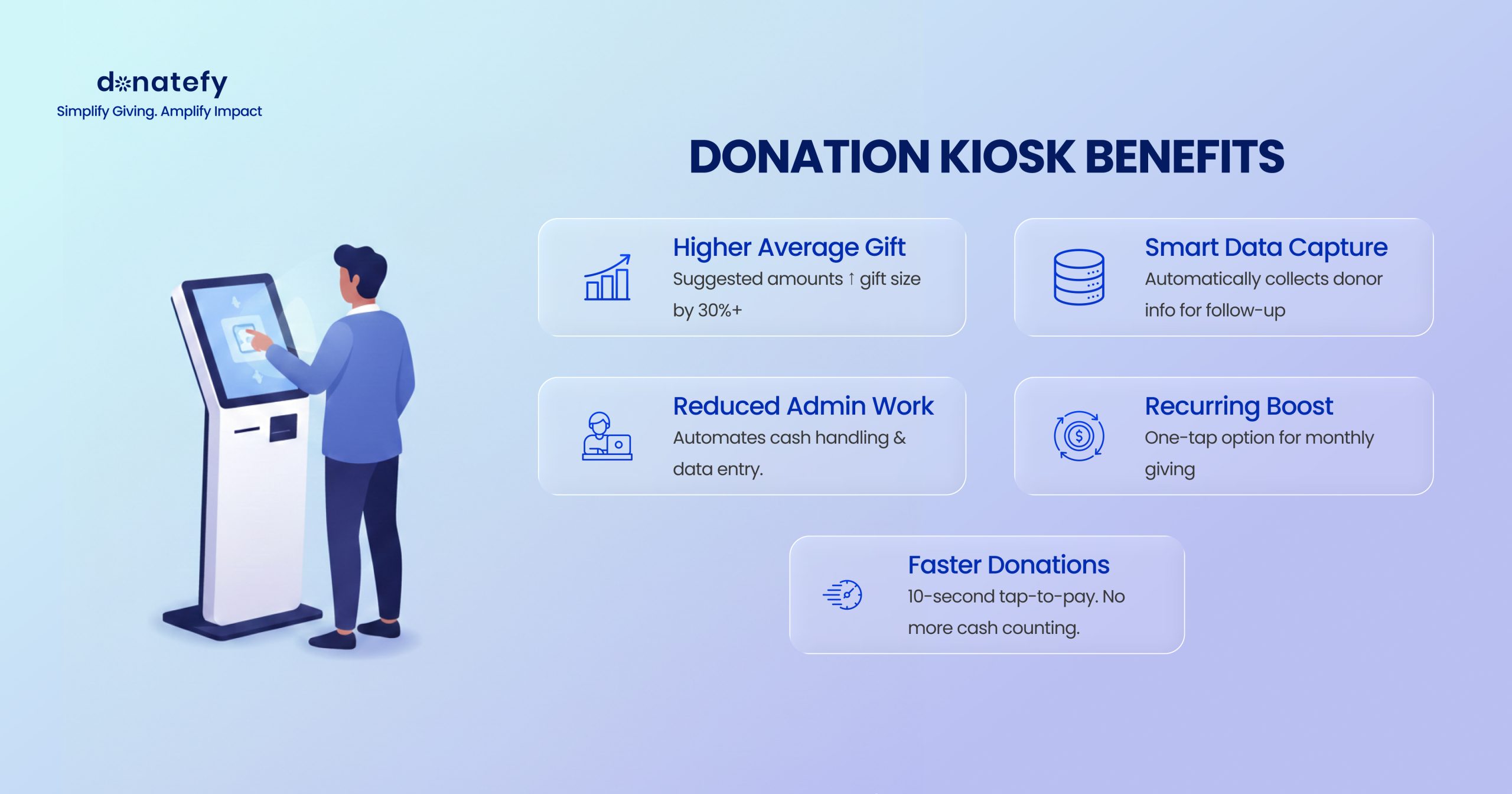
Data consistently shows that digital donors give more than cash donors. While a person might drop a $5 or $10 bill into a bucket, the “one-tap” buttons on a donation kiosk typically start at $20, $50, or $100. By suggesting specific amounts, you anchor the donor’s expectations higher.
2. Frictionless “Tap-to-Pay” Experience
In 2026, donor behavior is driven by speed. A kiosk removes the need for filling out paper forms or navigating multi-step web checkout pages. A donor can complete a transaction in under 10 seconds, which is critical during high-traffic events or at the conclusion of a service.
3. Automatic Donor Data Capture
Cash is anonymous. Digital giving is data-rich. Donatefy donation kiosk allows you to capture names and email addresses (compliant with privacy regulations). This transforms a one-time spontaneous giver into a lead in your CRM for future nurturing.
4. Seamless Recurring Giving
One of the most powerful features of modern kiosks is the “Recurring donation” toggle. Converting a one-time event attendee into a sustaining donor at the point of inspiration is the fastest way to increase a donor’s Lifetime Value (LTV).
5. Reduced Administrative Burden
Handling cash and checks is expensive. It requires manual counting, dual-control security, physical transport to the bank, and manual data entry. Donation kiosks automate the entire pipeline; funds are deposited directly, and digital receipts are issued instantly.
“We replaced cash boxes with a donation kiosk at our Friday services and immediately saw higher donations. Most people tapped to give in seconds, and capturing emails changed how we follow up.”
Donation Kiosk Cost Breakdown (2026)
Transparency is vital for board approval. Investing in a donation kiosk involves four primary cost centers.
Hardware Costs
This is a one-time and long-term investment. Prices vary based on form and size:
- Handheld/Tabletop: $300 – $800
- Freestanding Pedestals: $1,000 – $4,000
Donatefy primarily offers two high-definition touchscreen sizes that can be configured as wall, floor, or table mounts:
- 15” Kiosk: $599
- 22” Kiosk: $799
Note: These come “ready to use out of the box” with integrated card readers.
Software & Platform Fees
This is where functionality lives. Most providers charge a monthly or annual SaaS fee to maintain the secure interface, data encryption, and dashboard reporting. This usually ranges from $30 to $150 per month per device.
With Donatefy, these fees consolidate your operational costs, providing a comprehensive platform that includes all essential features without hidden charges.
Transaction Fees
All donations made through Donatefy donation kiosks are securely processed using Stripe, a globally trusted, PCI-compliant payment processor used by millions of organizations worldwide.
For nonprofits, rates typically fall into the following categories:
- 2.2% + $0.30 per transaction
Applies to registered U.S. 501(c)(3) nonprofit organizations - 2.9% + $0.30 per transaction
Applies to organizations that do not qualify for nonprofit status
 Pro Tip: Donatefy kiosks include a “Cover the Fees” option. On average, around 85% of donors choose to cover the processing fee, significantly reducing the nonprofit’s net cost while keeping the donation experience frictionless.
Maintenance and Connectivity
You will need a stable internet connection (Wi-Fi or a cellular SIM card). Cellular data plans for kiosks are generally $10–$20 per month.
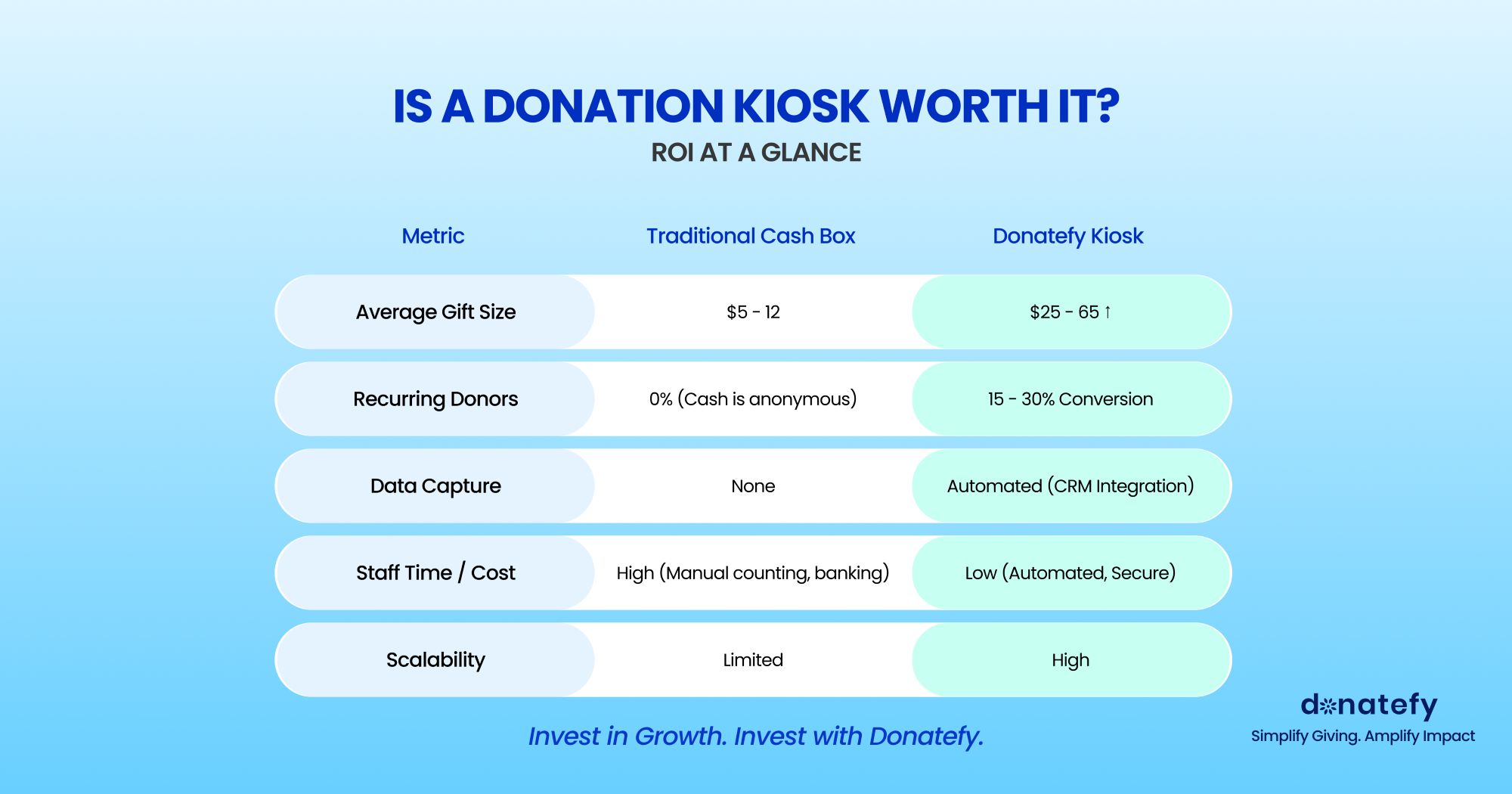
When evaluating donation kiosk cost, nonprofits must factor in the “Cost of Doing Nothing.” If you host an event with 500 people and 20% would have given $20 via tap-to-pay but didn’t have cash, you’ve lost **$2,000 in a single night**. The kiosk pays for itself within the first few events.
Donation Kiosk Cost vs Value: Is It Worth It?
The better question isn’t “How much does a donation kiosk cost?”
It’s “What does it return?” To justify the investment to your board, move the conversation from “expense” to “ROI.”
| Factor | One-Time Cost | Long-Term Value |
| Hardware | Fixed | Used across events & locations |
| Software | Predictable | Improves every donation |
| Transaction fees | Variable | Offset by higher gift size |
| Donor data | — | Compounds over time |
| Recurring donors | — | Predictable revenue |
What looks like an “expense” on paper becomes fundraising leverage in practice.
Lifetime Donor Value Changes Everything
A single monthly donor acquired through a kiosk can outperform dozens of one-time cash donations over time.
That’s how donation kiosks shift fundraising from transactional to sustainable.
Donation Kiosk Best Practices for Maximum ROI
Simply placing a kiosk in a corner isn’t enough. Success requires intentionality.
Strategic Placement
Place units in “transition zones” areas where people naturally pause but aren’t in a rush.
- Good: Near the exit after an emotional presentation, or next to a coffee station.
- Bad: In a dark corner or in the middle of a high-speed walkway.
Suggested Donation Amounts
Use the “Power of Three” to eliminate decision fatigue. Offer three clear choices (e.g., $25, $50, $100) plus an “Other” category. Anchoring a middle-tier amount as the “standard” choice can significantly increase your average donation size.
Branding and Visual Cues
A “naked” tablet looks like a retail POS and feels transactional. Use custom branding that incorporates your logo and a compelling call-to-action (CTA). Your kiosk should look like a dedicated “Giving Station,” not a cash register.
Staff and Volunteer Training
Staff and volunteers don’t need to sell; just guide donors with simple prompts like, “You can donate right here,” “It only takes a few seconds,” is often all it takes to trigger a donation.
Why Nonprofits Choose Donatefy
While there are many generic POS systems, Donatefy is built exclusively for the unique constraints of the nonprofit sector. We understand that you don’t need a retail checkout; you need a donor engagement tool.
Designed for Speed: Quick Donate
Our interface is stripped of all unnecessary steps. We prioritize the Quick Donate flow, allowing a supporter to give and get on with their day in seconds.
Built-In Recurring Giving
Donatefy makes Recurring Donations a native part of the experience. We help you turn one-time momentum into long-term sustainability.
Custom Branding Without the Headache
Every Donatefy kiosk can be fully branded to match your organization’s visual identity. We provide the hardware, the software, and the support, so you can focus on your mission rather than troubleshooting tech.
Proactive Monitoring & Remote Support
You shouldn’t have to be a tech expert to run a fundraiser. Every Donatefy kiosk includes proactive remote monitoring 24/7. Our team keeps an eye on your hardware’s health and provides remote support, ensuring your kiosks are ready to perform whenever your donors are.
The Most Cost-Effective Professional Solution
We believe high-impact technology should be accessible to organizations of all sizes. Donatefy offers a low-cost entry point with transparent pricing, ensuring that your hardware and software investment pays for itself through increased gift sizes and reclaimed staff time.
Conclusion: Take the Friction Out of Giving
The question for nonprofits in 2026 is no longer if you should adopt digital giving technology, but how quickly you can implement it. A donation kiosk isn’t just a way to collect money; It’s a way to respect your donors’ time, meet modern expectations, and capture generosity at the exact moment it happens.
By removing the friction of cash and the time-drain of manual data entry, you empower your community to support you at the exact moment they feel inspired.
The cost of a kiosk is a fraction of the potential revenue left on the table every year.
For nonprofits serious about growth, donor retention, and modern giving, the real question isn’t if donation kiosks make sense; it’s how soon you put one to work. Explore how a Donatefy donation kiosk can make in-person giving simpler and more convenient for your supporters.